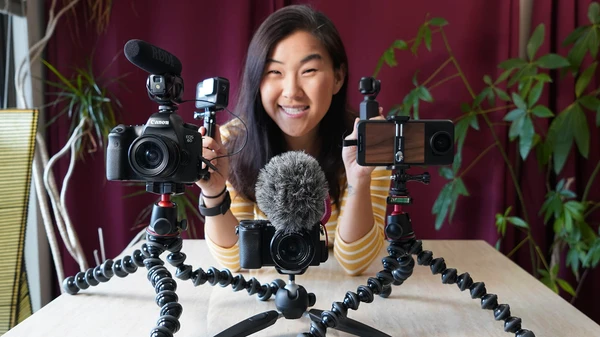
Filming yourself with a phone gets old fast. You walk out of frame, the shot drifts while you talk, the battery drains halfway through the day, and you end up holding your arm out for every clip.
A pocket vlogging camera fixes that. It keeps you in frame on its own, lets you aim the lens where you need it, and records for hours, so you can focus on the moment instead of the camera.
We compared the pocket vlogging cameras sold in the US on their published video specs, subject tracking, ease of use, battery life, portability and verified owner feedback.
Video Quality
The resolution, sensor and color features each camera lists, and how good its footage is for everyday vlogs and social posts.
Tracking & Framing
How well each camera keeps you in frame while you move, and how flexibly you can aim the lens for different shots.
Ease of Use
How simple each one is to set up, record with and share from, especially for beginners and solo creators.
Battery & Portability
How long each camera records on a charge according to its listing, and how easy it is to carry in a pocket or bag.
The rankings on this page were produced by TT-Marketing Ltd, an outside firm that earns no commission from sales and holds no ownership interest in any product listed.
All models were scored using the same pre-set formula based on product specifications, verified customer review data, and seller return policies collected from Amazon US on July 28, 2026. The criteria and their weights were finalized before any product was scored, and the results can be independently recalculated using the substantiation report.
TT-Marketing also evaluated products hands-on. These observations inform the written reviews but do not affect the numerical rankings. Statements marked [tested] are based on hands-on testing. Figures marked with an asterisk (*) are manufacturer- or seller-provided claims that have not been independently verified.
After comparing published video specs, tracking, ease of use, battery life, portability and verified owner feedback, here are the Top 5 Best Vlogging Cameras for 2026.


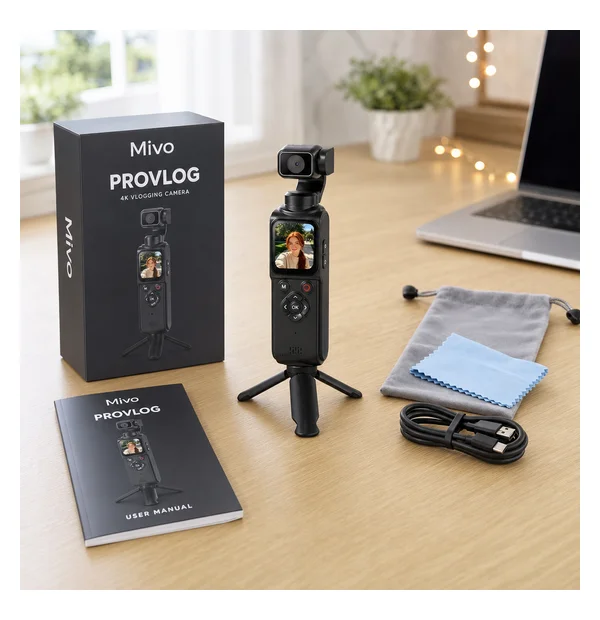

The Mivo ProVlog is our #1 pick for 2026. It is perfect for creating high-quality vlogs, capturing everyday moments and sharing your adventures online.
It is a pocket-size 4K vlogging camera built for solo creators. AI auto tracking follows your movements and keeps you in frame, so you can record hands-free without a camera operator. A 330° rotating lens lets you switch perspectives in a second, and 31 built-in filters plus a Beauty Mode give your clips a finished look straight out of the camera.
What sets it apart is how easy it is to live with. A 2400mAh battery delivers up to 180 minutes of continuous recording, enough for a full day out. One-tap WiFi sharing sends photos and videos to your phone so you can post right away, and over USB it works as a webcam for video calls, online meetings and livestreams.
To be straight about the trade-offs: the Insta360 Luna Pro, DJI Osmo Pocket 3 and Xtra Muse use larger 1-inch sensors and 3-axis mechanical stabilization, and the SJCAM C400 lists a longer battery life and a waterproof kit. If you want an easy, pocket-size camera that keeps you in frame and records all day at a far lower price, the ProVlog is the best all-rounder we found.
VISIT SITE

The Mivo ProVlog earns its #1 spot by making vlogging effortless. AI tracking keeps you in frame, the 330° lens covers every angle, and up to 180 minutes of recording gets you through the day. Other cameras here have bigger sensors or mechanical stabilization, but they cost far more and are built for more advanced shooters.
Mivo offers free shipping and easy returns. It was our unanimous pick for the best vlogging camera in 2026.
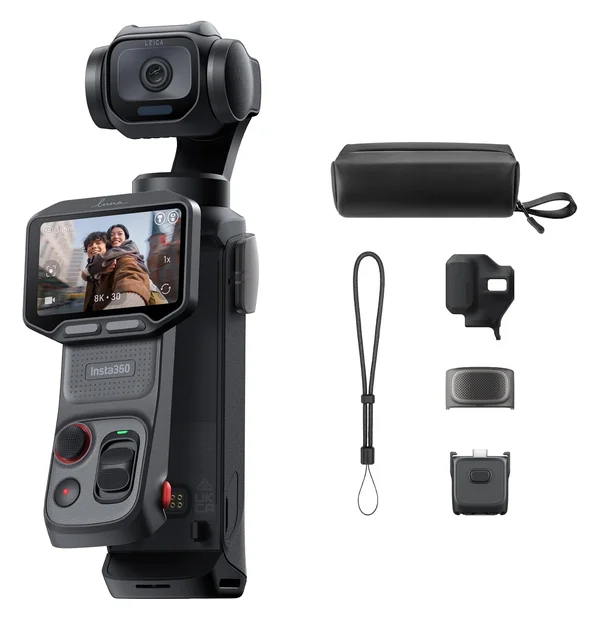

If you want cinema-grade footage and price is no object, the Insta360 Luna Pro is the flagship of this list.
It has a 1-inch 8K sensor that shoots up to 8K at 30fps with Dolby Vision, up to 14 stops of dynamic range and Leica color profiles. Its detachable 2" OLED touchscreen works as a remote up to 20m away, it offers 4x HighRes Zoom, and 3-axis mechanical stabilization with AI tracking keeps you centered. Owners rate it 4.9 stars across 185 ratings.
It ranks second because it is by far the most expensive camera on this list, at around four times the price of our top pick, and its listing does not state battery life. If you want 8K footage and pro color, it is an impressive machine.
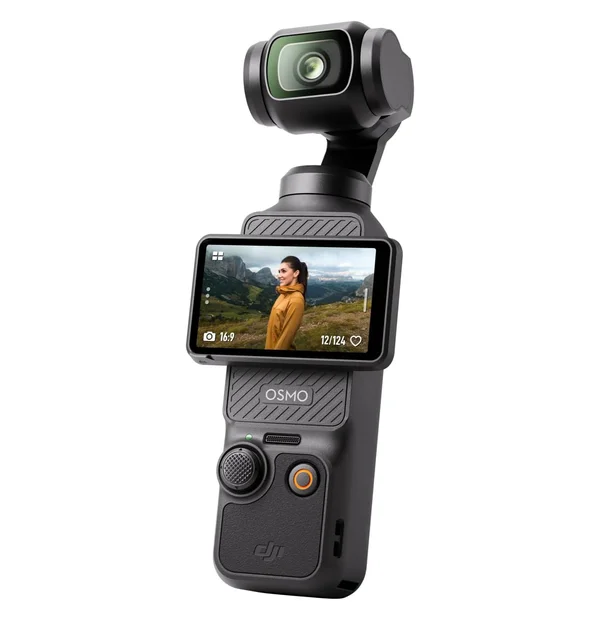

If you want the best-known pocket gimbal camera with the biggest owner base, the DJI Osmo Pocket 3 is a proven pick.
It uses a 1-inch CMOS sensor that records 4K at up to 120fps, a 2-inch rotating touch screen for horizontal or vertical shooting, and 3-axis mechanical stabilization. ActiveTrack 6.0 keeps you centered, D-Log M with 10-bit color gives editors room to grade, and it records in stereo. Owners rate it 4.5 stars across 10,670 ratings.
It ranks third because it costs well over twice as much as our top pick, and owner reviews are mixed on battery life, with some saying it runs out of charge very fast. If you edit your footage and want pro color, it is a capable camera.
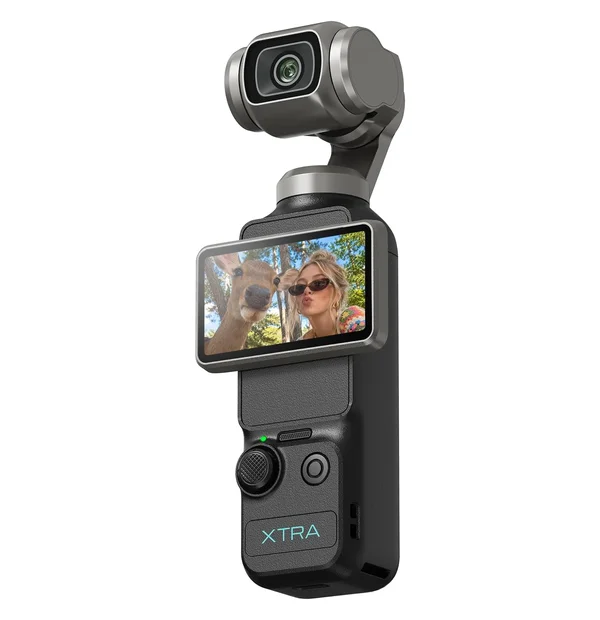

If you want 1-inch sensor footage for a little less than the big names, the Xtra Muse is a solid alternative.
It pairs a 1-inch CMOS sensor that records 4K at 120fps with a 3-axis gimbal stabilizer and a 2-inch touch screen for horizontal and vertical shooting. Master Follow keeps you centered, and 10-bit X-Log color modes give you room in post-production. Owners rate it 4.4 stars across 461 ratings.
It ranks fourth because it still costs more than twice as much as our top pick, and owner reviews are mixed on battery life and reliability, with some saying the battery dies quickly. If you want a 1-inch sensor without paying flagship prices, it is worth a look.
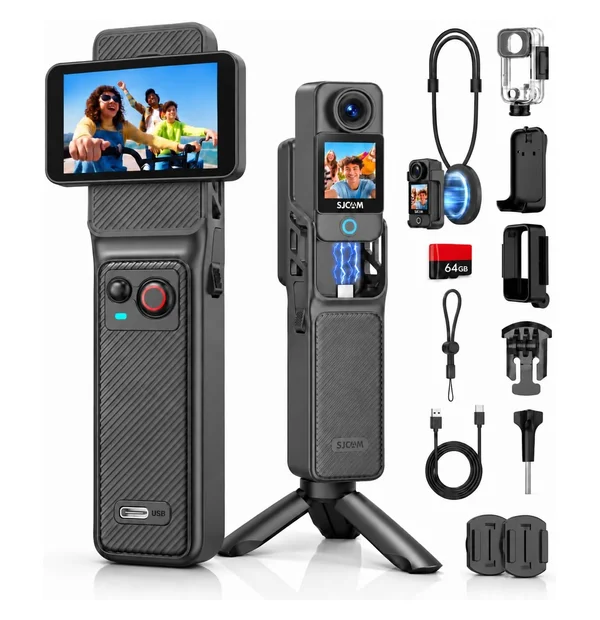

If you want long battery life and action-camera toughness, the SJCAM C400 is the outdoor option on this list.
It records 4K Ultra HD through a 154° wide-angle lens with an f/2.0 aperture, and its listing states up to 7 hours (460 minutes) of continuous shooting. The handheld controller detaches for wireless preview and control, 6-axis electronic stabilization smooths action shots, and it comes with a waterproof kit rated to 30m. Owners rate it 4.1 stars across 216 ratings.
It ranks fifth because it costs more than our top pick, its listing does not state AI face tracking, and owner reviews are mixed on video quality. If you mostly film sports and outdoor adventures, it is a solid option.
A phone can shoot good video, but it was never designed for filming yourself. You have to hold it at arm's length, you drift out of frame when you move, and long recording drains the battery you need for everything else. A pocket vlogging camera is built for exactly this job. It sits on a mini tripod or in your hand, keeps you in frame while you talk or move, and records for hours without touching your phone's battery. When you're done, you send the clips to your phone and post them. The main differences between models are the sensor and resolution, how they keep the shot steady and centered, how long they record, and how easy they are to use. For most creators, a camera that tracks you automatically and is simple to share from is the easiest to live with.